


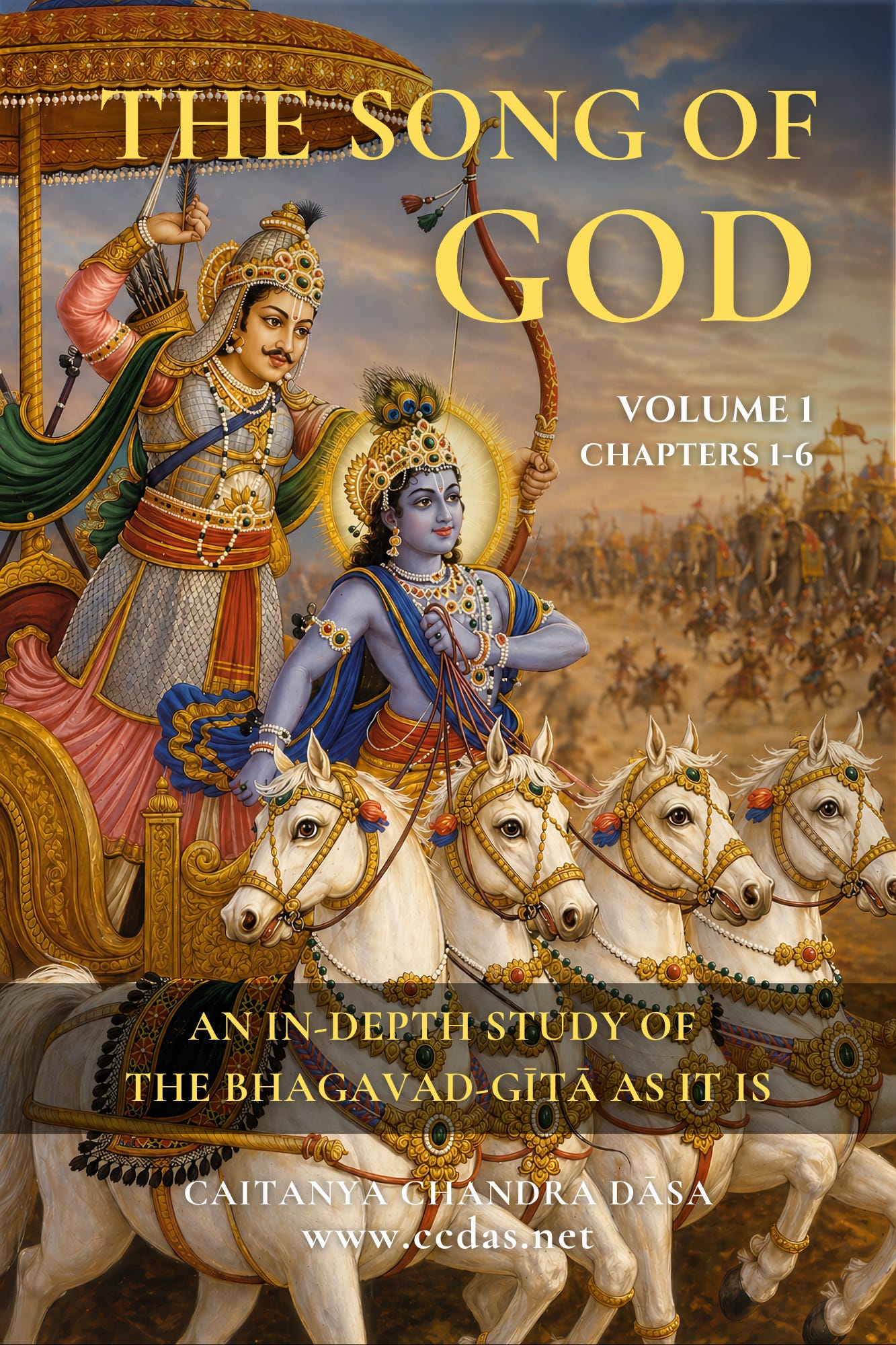
The Bhagavad-gītā is one of the foundational books of Kṛṣṇa consciousness, yet many readers find it difficult to grasp. Often, we understand individual verses but miss the overall progression, or we finish the book remembering the conclusion while forgetting most of the arguments that sustain it. In this way, although we study the Bhagavad-gītā As It Is, we often fail to capture the complete thread of Kṛṣṇa’s teachings.
This book was written as a companion to Bhagavad-gītā As It Is by Śrīla Prabhupāda. It is not meant to replace the original text but to help you understand the structure, progression, and practical application of the teachings. Here, the verses are grouped and explained according to the natural progression of Kṛṣṇa’s argument, making it easier to see how one point leads to the next, how the different sections fit together, and how Śrīla Prabhupāda’s purports reveal the meaning and implications of each passage. Studying in this way, you can understand each verse individually while also capturing the thread of the conversation and seeing how everything comes together to form a unified message.
You may read this book from beginning to end as a continuous journey through the Gītā or go deeper, using it as a study guide alongside the Bhagavad-gītā As It Is. In either case, this book is meant to help you understand Kṛṣṇa’s teachings more clearly, appreciate Śrīla Prabhupāda’s explanations more deeply, and apply them in practical life.
📚 Would you like a printed copy?
The complete book is already available on Amazon, both printed and Kindle. You can get yours today:
US , UK , DE , FR , ES , IT , NL , JP , CA , AU, PL, SE, BE, IE, JP
There is also a digital version of the book available for subscribers on the upcoming books page.
➡️ Read the book online
New topics are being published daily. At the end, we will have the PDF available to everyone.
+ Why would one want to study the Bhagavad-gītā?
+ Introduction: The conclusions of the Bhagavad-gītā
+ CHAPTER ONE: Observing the armies on the battlefield of Kurukṣetra (Arjuna-viṣāda yoga)
Signs of victory: the sounding of the conchshells (Bg 1.12 to 1.19)
Arjuna sees the armies, and his heart shatters (Bg 1.24 to 1.27)
+ CHAPTER TWO: Contents of the Gītā Summarized (Sānkhya-yoga)
Kṛṣṇa argues from the atheistic perspective (Bg 2.26 to 2.28)
The amazing people who can see the amazing soul (Bg 2.29 and 2.30)
You have a right to perform your duty, but not to enjoy the fruits (Bg 2.47 to 2.53)
Four questions: The characteristics of a pure devotee (Bg 2.54)
Arjuna becomes confused after Kṛṣṇa’s instructions (3.1 and 3.2)
Whatever action a great man performs, common men follow (3.17 to 3.24)
The learned guides others without disturbing them (3.25 and 3.29)
+ CHAPTER FOUR: Transcendental Knowledge (jñāna-karma-sannyāsa yoga)
The disciplic succession (4.1 to 4.3)
The mystery of Kṛṣṇa's appearance and activities (4.4 to 4.10)
As all surrender unto Me, I reward them accordingly (4.11 to 4.15)
The intricacies of action (4.16 to 4.18)
Action with knowledge and detachment (4.19 to 4.24)
Different types of sacrifice (4.25 to 4.32)
The glories of transcendental knowledge (4.33 to 4.38)
Faith, doubt, and determined action (4.39 to 4.42)
A map of the fourth chapter of the Gītā
+ CHAPTER FIVE: Karma-yoga – Action in Kṛṣṇa consciousness (Karma-sannyāsa yoga)
Devotional action is better than renunciation of work (5.1 to 5.6)
Niṣkāma-karma-yoga: Remaining free from bondage (5.7 to 5.12)
The liberated soul does not create activities, nor induces others to act (5.13 to 5.16)
The vision of the self-realized (5.17 to 5.21)
Resisting the urges of the senses and attaining liberation (5.22 to 5.26)
Introducing dhyāna-yoga and its goal (5.27 to 5.29)
A map of the fifth chapter of the Gītā
+ CHAPTER SIX: Dhyāna-yoga
Yogārurukṣu and yogārūḍha: two stages in the practice of yoga (6.1 to 6.9)
The practice of aṣṭāṅga-yoga (6.10 to 6.15)
The perfectional state of yoga meditation (6.16 to 6.23)
The vision of the perfect yogī (6.24 to 6.32)
Controlling the turbulent mind (6.33 to 6.36)
The fate of the unsuccessful yogī (6.37 to 6.45)
The devotee is the topmost yogī (6.46 and 6.47)
A summary: the progression of the yoga processes described in the Bhagavad-gītā
From animal life to devotional service
The path of bhakti
A clear path
Karma and jñāna
The yoga ladder of the Bhagavad-gītā
Devotion is the measure of success
The path to perfection
A map of the sixth chapter of the Gītā
⤵️ Download the ebook:
You will be able to see the PDF of the book here once it is complete. For now, you can read the chapters as they are published.